
How Fabric works
Fabric AI Gateway sits between your apps and agents and the models, tools, and APIs they call. It has two parts: a control plane, where you configure routes, policies, and access, and a data plane, which carries the traffic. Postman can host the data plane for you, or you can run it in your own cloud. For details, see Choose a deployment model.
How it works
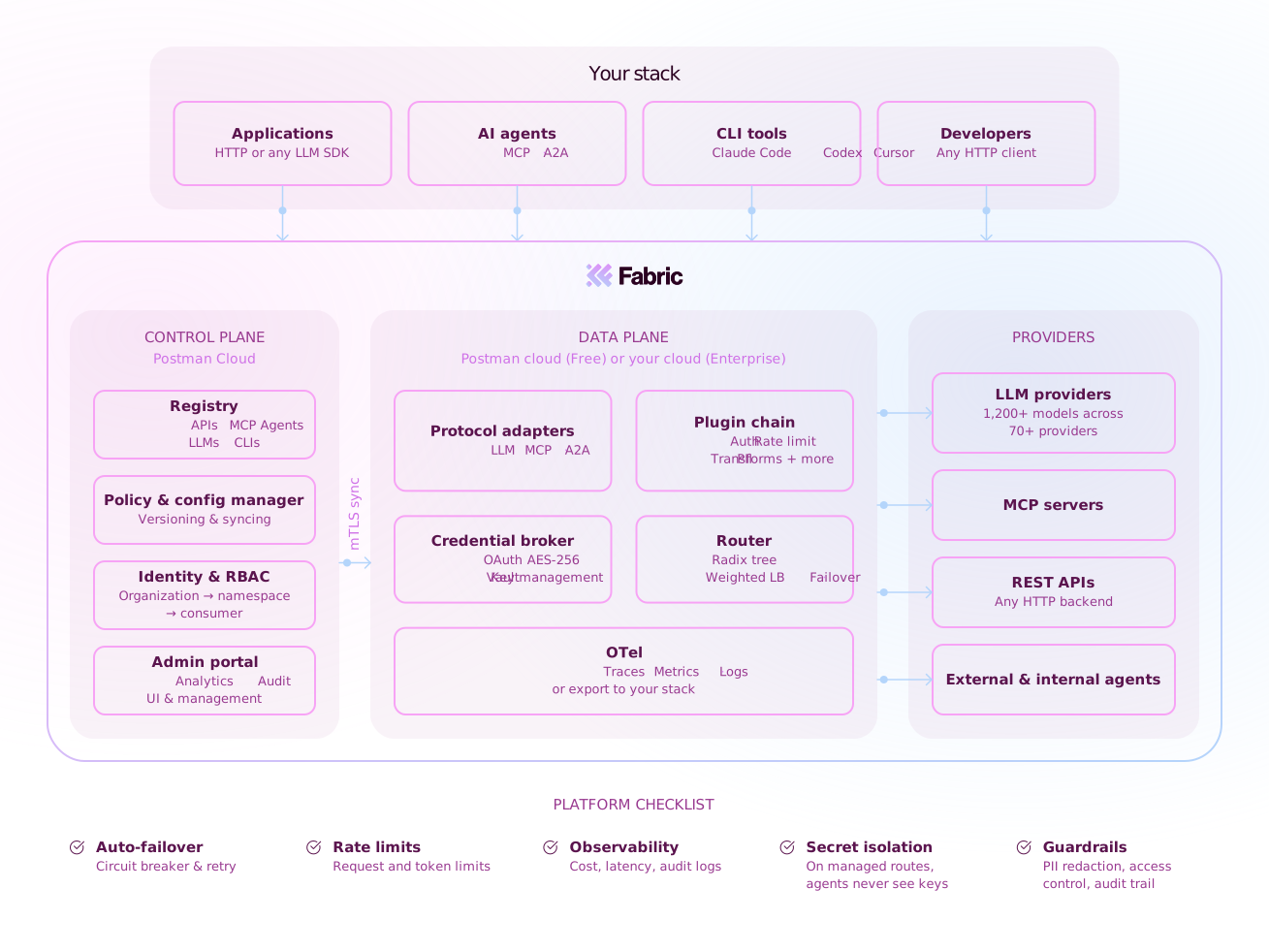
A control plane handles configuration, identity, and governance. A data plane handles all runtime traffic. The data plane opens an outbound network connection to the control plane, secured with mutual TLS (mTLS), and receives configuration and policy changes over it as you make them. It keeps a local copy of the latest configuration, so it continues to serve traffic if the control plane is temporarily unreachable.
Apps, AI agents, IDEs, and services send requests to the gateway over HTTP, MCP, or A2A. The gateway routes each request to the right upstream, which is a system that the gateway calls: an LLM from any of 70+ providers, an MCP server, a REST API, or another agent.
Components
The architecture has four parts: your stack (the clients that send requests), the control plane, the data plane, and providers (the upstream LLMs, MCP servers, APIs, and agents the gateway routes to).
Your stack
Clients are the apps, agents, and tools that send requests to the gateway. The data plane processes them according to the policies and configuration that you define in the control plane.
All client types send requests into the data plane.
Control plane
The control plane handles administration and never sits in the request path. It includes the following:
- An Admin API (REST, with RBAC)
- Versioned per-organization configuration and policy
- A certificate authority and enrollment (X.509, auto-renewing)
- A read-only fleet view of node health
- Usage and billing metering
The control plane talks to the data plane over mTLS. In an enterprise deployment, the data plane always dials out to the control plane and never accepts connections from it.
The control plane has the following key components:
- Registry — A central catalog of APIs, MCP servers, agents, LLMs, and CLIs.
- Policy and config manager — Versions policy and configuration, and syncs them to your data plane nodes.
- Identity and RBAC — Controls who can manage the organization and its namespaces, and which consumers can call each service.
- Admin portal — Provides analytics, audit logs, and UI-based management.
Data plane
The data plane handles every request. It includes the following:
- A listener on port 8080, which serves HTTPS on the same port when you configure a TLS certificate
- A router that matches on host, path, method, and header
- Protocol adapters for MCP, A2A, and LLM traffic
- A policy chain of built-in plugins
- A credential broker that removes the caller’s credential and adds the upstream credential
- An upstream manager (load balancing, circuit breakers, and failover)
- Local state, which is an encrypted configuration cache plus your own vault and database
The data plane has the following components:
- Protocol adapters — Translate LLM, MCP, and A2A requests into a common format, so the same policies and telemetry apply across protocols. Other HTTP requests pass through without an adapter.
- Plugin chain — Runs the plugins attached to a route, in order. For the full list, see the plugin reference.
- Credential broker — Manages OAuth flows, AES-256 encryption, and vault and key storage.
- Router — Routes with a radix tree, weighted load balancing, and failover.
- OTel — Emits traces, metrics, and logs, which you view in the console or export to your own stack.
Providers
Fabric AI Gateway connects to LLM providers, MCP servers, REST APIs, and agents. The catalog includes 70+ LLM providers and 1,200+ models. Which ones you can use depends on your organization and on the models your admins allow.
| Provider type | Examples |
|---|---|
| LLM providers |  Anthropic,  OpenAI,  Moonshot (Kimi), and  Mistral; 1,200+ models are available depending on provider and tenant. |
| MCP servers |  Atlassian,  Notion, and many more. |
| REST APIs | Any HTTP backend. |
| Agents | Internal and external agents. |
Request flow
A request follows these steps:
- A client sends a request.
- The router matches the request to a route by host, path, method, and headers.
- A protocol adapter translates LLM, MCP, and A2A requests into a common format. Other HTTP requests skip this step.
- The plugin chain runs the plugins configured for the route, for example authentication, rate limiting, or PII redaction.
- The upstream manager selects a healthy upstream using weighted load balancing.
- The credential broker replaces the caller’s credential with the upstream credential.
- The data plane forwards the request to the upstream.
Throughout, OpenTelemetry captures traces, metrics, and logs. Configuration changes reach the data plane separately, over its network connection to the control plane.
Next steps
- To compare the hosted and hybrid models and the Free and Enterprise plans, see Choose a deployment model.
- To see what stays in your network and how the platform protects secrets, see Review security and data handling.
- To follow one request through the data plane, see Follow a request through the gateway.
- To connect your first provider, start with Quickstart: Send your first request on the hosted gateway.